Pages

2007-09-04

How to Hack ISO

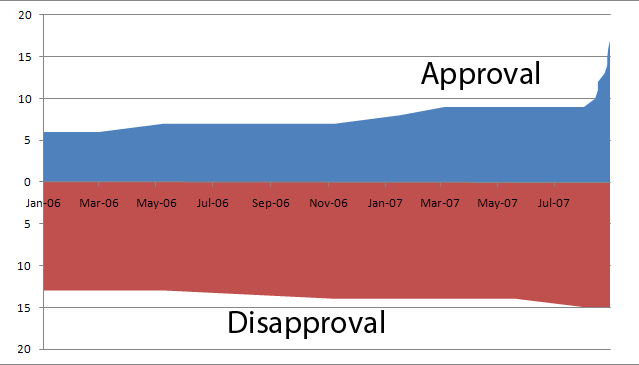
JTC1 has historically had a rather stable membership of NB's active in its technical agenda. There has been a slow increase in membership, 1 NB joining in 2001, but none in 2002, 4 joining in 2003, 1 joining in 2004, none in 2005, 4 joining in 2006. But in 2007 JTC1 has been blessed with 12 new P-members, many of then joining in only the last week.

http://www.robweir.com/blog/2007/09/how-to-hack-iso.html

The results of the ISO voting: Office Open XML is Disapproved

" The official word is not yet released, but I have seen the results. UK disapproved, as did Ireland. So did Canada. So did the Czech Republic and Korea. "

http://www.groklaw.net/article.php?story=20070904082606181

"O frabjous day! Callooh! Callay!'
He chortled in his joy."

ISO - Vote closes on draft ISO/IEC DIS 29500 standard

"A ballot on whether to publish the draft standard ISO/IEC DIS 29500, Information technology – Office Open XML file formats, as an International Standard by ISO (International Organization for Standardization) and IEC (International Electrotechnical Commission) has not achieved the required number of votes for approval."

http://www.iso.org/iso/pressrelease.htm?refid=Ref1070

Microsoft Fails to Gain Approval for OOXML

"All 41 P members voted, with the following breakdown: 17 yes, 15 no, and 9 abstain. A 66 2/3% majority was required, after subtracting abstentions. Instead, only a 53.12% approval was achieved. On the second test, a perhaps unprecedented 87 National Bodies voted, including Full Members that were not JTC1 members, as well as P (Participating) and O (Observer) members of JTC1. Out of this pool, 69 voted yes or no, with 18 voting no, or 26.08%, thus failing the second test: no more than 25% of all eligible votes can be no, after subtracting abstentions."

http://www.consortiuminfo.org/standardsblog/article.php?story=20070904053108577

Favorite Math Jokes

A farmer discovered his horse was extraordinarily intelligent. You could ask it an arithmetic problem, and it would tap out the answer with a hoof. Researchers were fascinated and tested the horse. They discovered the horse understood algebra, Euclidean geometry, calculus, and even group theory. However, when they gave the horse problems with Cartesian coordinates, it just stood there dumbly, like any horse. This was quite surprising, given how intelligent the horse was otherwise. They brought in an expert who examined the situation and explained the problem: "Of course the horse cannot understand any Cartesian coordinates you show it. You are putting Descartes before the horse."

http://edp.org/mathjoke.htm

Technical brief - OpenDocument Format

"The OpenDocument Format (ODF) is an open international standard that allows the exchange and retrieval of information in office documents.

ODF uses descriptive XML tags, so that large parts of an ODF document can be understood even without reading the specification.

ODF stores document content in a ZIP archive. Thus, unzipping an ODF file reveals XML streams, which then can be processed. The ZIP compression keeps the file size small without making the access difficult. Most programming and scripting languages, as well as build environments like Apache Ant, provide support for ZIP archives."

http://reddevnews.com/techbriefs/article.aspx?editorialsid=802


“Lucky Camera” takes sharpest ever images of stars

"A team of astronomers have taken pictures of the stars that are sharper than anything produced by the Hubble telescope, at 50 thousandths of the cost.

The researchers, from the University of Cambridge and the California Institute of Technology (Caltech), used a technique called “Lucky Imaging” to take the most detailed pictures of stars and nebulae ever produced – using a camera based on the ground. "

http://www.ast.cam.ac.uk/~optics/Lucky_Web_Site/LI_Press_Releases_0807.htm


"By using a high-speed camera we can choose those images that are least affected by the atmosphere and combine them to give a much higher resolution image then we would get if we simply added together all the images irrespective of their quality. By doing this we are selecting those fortunate moments when the fluctuations in the atmosphere are at the smallest. This is what we call "Lucky Imaging"."

http://www.ast.cam.ac.uk/~optics/Lucky_Web_Site/index.htm